Washington |

Featured Events


On July 26 the Representative of German Industry and Trade (RIGT), with the German Embassy, hosted a workshop entitled Climate Science: What we Know, What we Don’t, and Why It Matters to Industry. Matthias Sonn, Minister, Head of the Economic Department at the German Embassy, and Bernhard Welschke, the Representative of German Industry and Trade, provided introductory remarks. The workshop was held under the auspices of the Transatlantic Climate Bridge. A detailed recap can be accessed here.

Dr. Veronika Huber, visiting from the Potsdam Institute for Climate Impact Research, delivered keynote remarks. Ken Green, Resident Scholar at the American Enterprise Institute, responded. Anna Schneider, Vice President for Industry-Government Relations at Volkswagen Group of America, and Stephen Eule, Vice President for Climate and Technology at the Institute for 21st Century Energy, provided the industry perspective.


Dr. Huber

Dr. Huber reviewed the latest findings regarding climate change science, touching on the link between increasing greenhouse gas (GHG) concentrations and rising global mean temperatures, and the risks that global warming pose to society.
Green questioned the methodology used to substantiate the theory that anthropogenic GHG emissions are causing global temperatures to rise, noting that, even if global warming is occurring, warmer climates may deliver certain benefits.

Anna explained that VW is pursuing a multi-year strategy to produce high-performance motor vehicles that will emit fewer GHG emissions and contribute to a cleaner environment. The upgrades will occur across the company’s entire product line: low-sulfur, fuel-efficient diesel motors, electric hybrids, fuel cell-powered cars.

Ken Green, Anna Schneider, Minister Sonn, Bernhard Welschke, Stephen Eule, David Campbell, Dr. Huber

Eule applauded the objectives of the landmark climate and energy bill that passed the House of Representatives last year but critiqued the provision for subjecting U.S. industry and U.S. consumers with excessive costs. The US economy cannot bear the higher energy and compliance costs, which would be passed through in large measure to end-users, Eule maintained.

The Senate was unable to introduce climate and energy legislation before leaving Washington for the Augsut recess. With the mid-term elections taking place in November, the prospects for Congressional action on a comprehensive climate and energy bill are dim.


AICGS and RGIT host Symposium on Transatlantic Relations

On June 30, 2010 the
Representative of German Industry and Trade (RIGT), with the American Institute for Contemporary German Studies (AICGS), hosted a symposium entitled The U.S., the Euro Zone Crisis and Transatlantic Relations. Peter Rashish, U.S. Chamber of Commerce, delivered keynote remarks, followed by a panel involving David Campbell, RGIT; Nicolas Veron, Peterson Institute for International Economics; and Stormy-Annika Mildner, SWP. Jack Janes, Executive Director of AICGS, moderated. RGIT is pleased to provide a recap of Campbell's remarks (Report) along with his Power Point presentation.


David Campbell, Stormy-Annika Mildner, Jack Janes, Peter Rashish, Nicolas Veron

Veron discussed the state of the financial-capital markets, describing recent developments in Brussels and Washington, and indicating opportunities for greater transatlantic collaboration with regard to capital markets, and the regulation of banks and financial institutions.

Mildner addressed the state of transatlantic relations re trade, noting that Congress has not ratified the free trade agreements (FTAs) with Colombia, Panama and South Korea while the European Union has pursued FTA negotiations with Canada and South Korea. Mildner explained that cultural, political and technical reasons hinder efforts to achieve closer transatlantic regulatory harmonization.

Campbell addressed the potential for greater German-American and transatlantic cooperation on energy, detailing the respective energy mix and energy use profile in the two countries, and contrasting the how energy security is debated in Washington, where the focus is on oil, and in Berlin, where the focus is on natural gas. Campbell explained that the EU-U.S. Energy Council and the Innovation Action Partnership can promote greater cooperation on energy efficiency, energy policy and energy security.


Past events 

Eule applauded the objectives of the landmark climate and energy bill that passed the House of Representatives last year but critiqued the provision for subjecting U.S. industry and U.S. consumers with excessive costs. The US economy cannot bear the higher energy and compliance costs, which would be passed through in large measure to end-users, Eule maintained.

The Senate was unable to introduce climate and energy legislation before leaving Washington for the Augsut recess. With the mid-term elections taking place in November, the prospects for Congressional action on a comprehensive climate and energy bill are dim.


English VersionEnglish
Deutsche VersionDeutsch

Our Principals


DIHK:

www.dihk.de

BDI:

www.bdi.eu


“German Business Matters - A U.S. and State-by-State Analysis“


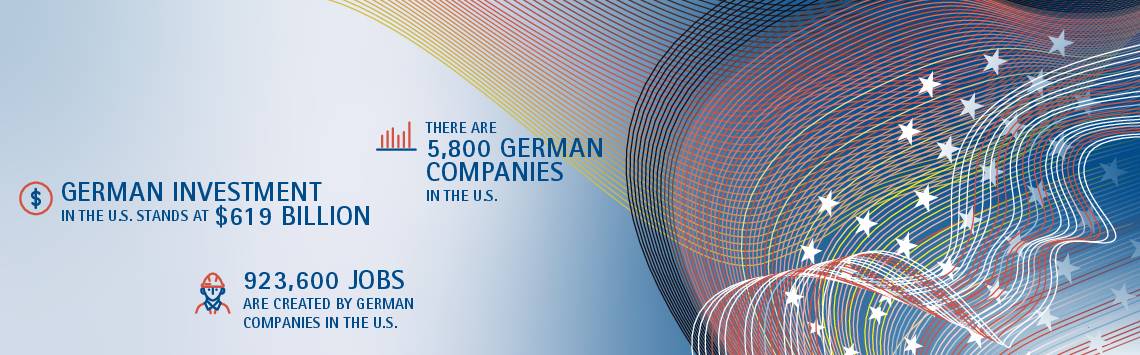
More than 3,000 German companies operate in the U.S. They account for approx. 675,000 jobs. more